This is a SEO version of Toledo Football Media Guide - 2012. Click here to view full version
« Previous Page Table of Contents Next Page »HISTORY 145
ass Bowl History

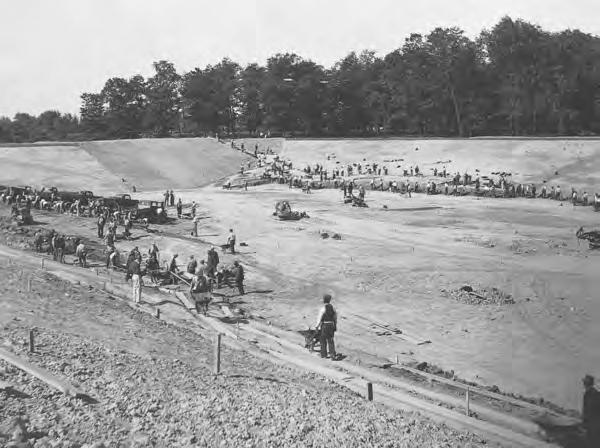
The Glass Bowl, today one of the premier college football facili-ties in the country, had a humble beginning. Built by the Works ProgressAdministration in1936, it wasoneof65projectsundertaken by the WPA in Ohio that year. Workers used picks, shovels and wheelbarrows to carve out a site for the structure south of campus, removing more than 13,000 square yards of earth from a natural ravine. The work was done entirely by manual labor, as bulldozers and other machinery were not available.
The project was paid for with $272,000 fromthe federal govern-ment and $41,558 from the city of Toledo and the university. The 300-man crew needed over one year to complete the work. The new stadium had many modernfeatures, includingapress box, aone-storywoodenstructure
with fve windows located on the east side. Two stone tow-ers, which still are in use today, were built on the north side and were used as locker rooms and at one point served as living accomodations for 12 players.
Originally known as University Stadium, it initially had a seating capacity of 8,000, which was increased to 11,500 in 1940. The largest pre-war crowdwas 9,500 for a 13-7 Rocket
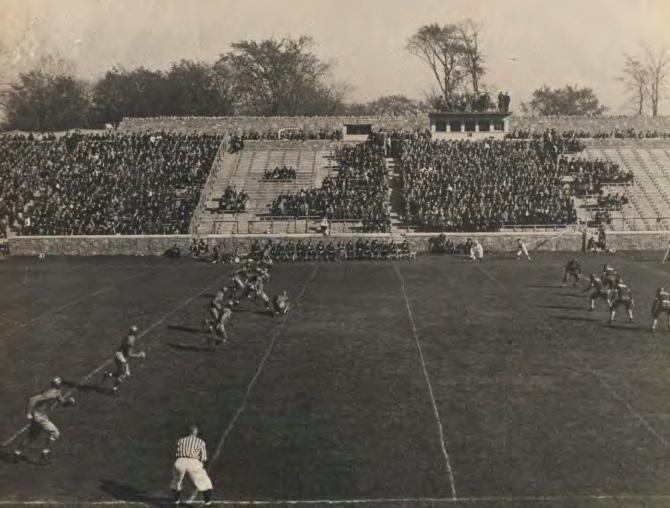
victory over 12th-ranked Marshall in 1938.
Thestadiumfell intodisrepair followingnearly four years of vacancy (1942-45) during thewar, when football was dis-continuedatUT. In1946,WayneKohn, a Libbey-Owens Ford engineer, conceived of the idea of using glass to rebuild the stadium.Glassblockswere installedthroughout thestadium and a glass electric scoreboard was built in the south end zone. A new two-tier press box of blue vitrolite and glass
blockswas alsoconstructed. Lightswere installed, beginning the tradition of night football at UT. The newly renovated stadium was ofcially named theGlassBowl inhonor ofToledo’sprimary industry. The Glass Bowl Dedication Game was played on Dec. 7, 1946 as a post-season game vs. previously undefeated Bates College. Toledo won the game, 21-12. Three more post-season “Glass Bowl Games” followed in 1947-49.
Seating capacity was increased to 12,800 in 1949, and to 15,900 in 1966.
Further stadium improvements were sparked by the outrageous success of the famous 35-0 Rockets of 1969-71. A second deck on the east side brought ofcial seating capacity to 18,500. A major improvement followed in 1974 when As-troturf was installed for the frst time at a cost of $404,000. Another$525,000was spent toupgrade
-Continued next page-
The Glass Bowl was dug out by hand byWPA workers in 1936.

KickoffromtheverygameintheGlassBowl,Sept.27,1937vs.Blufton.TheRockets prevailed that day, 26-0.
This is a SEO version of Toledo Football Media Guide - 2012. Click here to view full version
« Previous Page Table of Contents Next Page »